
Industrial plasma systems
Aufer Surface Tech, a division of Aufer Solutions S.L., supplies and integrates industrial plasma systems to activate surfaces and improve adhesion in manufacturing processes. We assess the material, part geometry, production speed and required result before defining the equipment configuration.
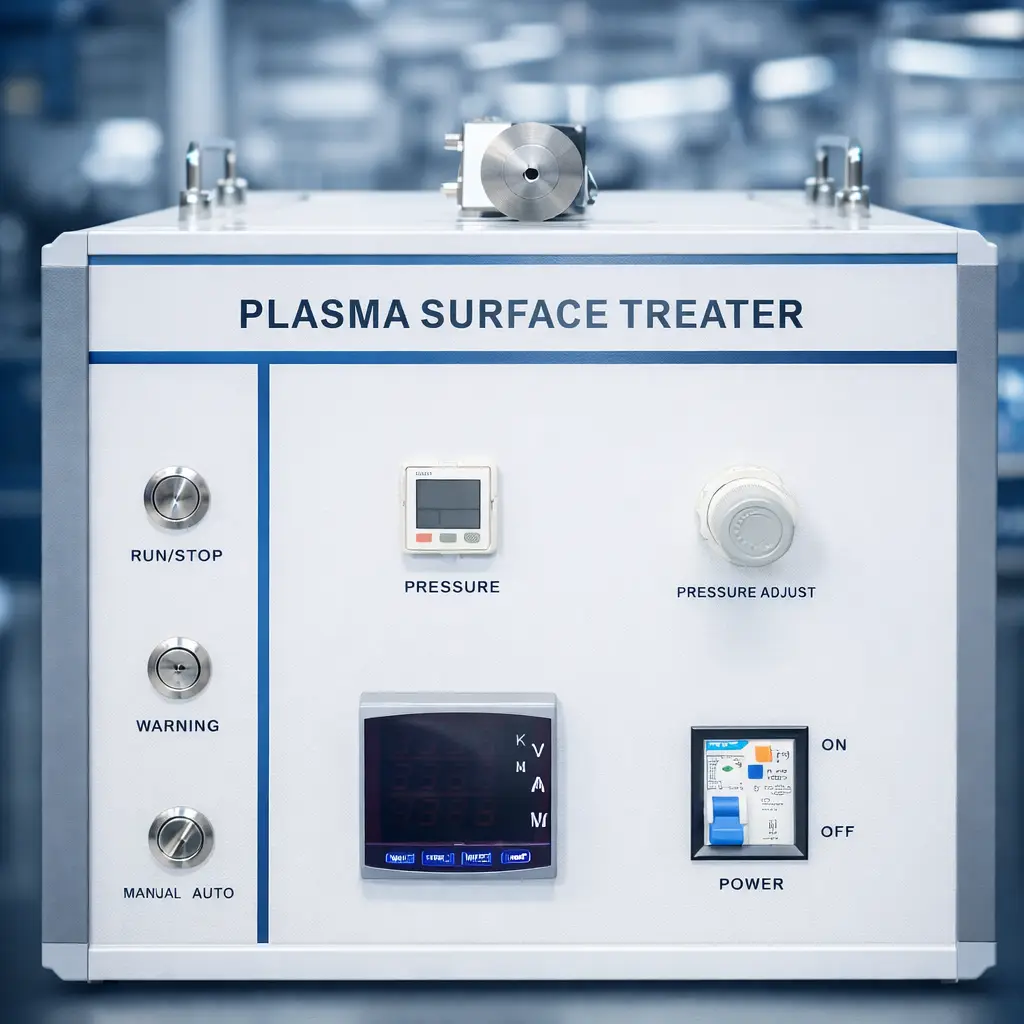
The objective is not simply to install a plasma generator, but to achieve a stable and repeatable treatment within the production line. We therefore carry out application trials and provide local technical support while the process is defined and integrated.
What is industrial plasma?
Industrial plasma modifies the outermost layer of a material using an ionised gas applied at ambient pressure. The treatment raises surface energy and improves wettability, supporting subsequent operations such as bonding, printing, painting, varnishing, coating and sealing.
The system operates without a vacuum chamber. This makes it possible to integrate the treatment directly into continuous processes, robotic cells, semi-automatic stations or manual workstations.
When should industrial plasma be used?
Industrial plasma is particularly suitable when treatment must be localised or applied to parts with three-dimensional geometries. Corona treatment is normally used for films, sheets and continuous materials, whereas plasma can focus activation on specific areas and precisely control the treated surface.
- Moulded or injection-moulded plastic parts.
- Technical components with complex geometries.
- Profiles, grooves and bonding areas.
- Surfaces that must be bonded, printed, painted or coated.
- Processes requiring localised, repeatable activation.
If your application uses a continuous material, see our industrial plasma and corona systems.
Industrial plasma configurations
The right configuration depends on the treatment width, the shape of the part and the available cycle time. Systems can incorporate one, two or multiple plasma jets, together with different nozzle types.
Rotary nozzles are available to cover areas up to 110 mm, while needle nozzles provide highly focused treatment. The solution can be integrated into manual, semi-automatic or fully automated processes.
Integration into production lines
An industrial plasma system must coordinate power, treatment distance, speed, nozzle movement and the time between activation and the next operation. Real production conditions and material variations must also be taken into account.
Aufer Surface Tech studies these parameters with the customer and defines the most appropriate integration solution for the existing installation. Where required, the system can operate inside an automated cell or in synchronisation with line movement.
Industrial plasma trials before selecting equipment
A trial using real samples verifies how the material responds and reduces the risk of choosing an unsuitable configuration. We assess the area to be treated, the downstream process and the expected production conditions.
This stage helps define the number of nozzles, treatment area, required power and automation strategy. See examples of industrial plasma and corona applications.
Industrial plasma for improved adhesion
Low-surface-energy materials may suffer adhesion failures, poor wetting or unstable printing and coating results. Industrial plasma activates only the surface layer, creating more favourable conditions for the following process without altering the overall geometry of the part.
The solution must always be validated with the material, adhesive, ink or coating that will be used in production. Application analysis is therefore an essential part of every project.
Frequently asked questions
What is the difference between industrial plasma and corona treatment?
Corona is mainly used to treat continuous materials uniformly at high speed. Industrial plasma is better suited to complex parts, 3D surfaces and localised activation.
Can the system be integrated into an existing line?
Yes. Integration can be adapted to continuous lines, robotic cells, automatic stations or manual processes, depending on cycle time and geometry.
How is the correct configuration determined?
We consider the material, treatment area, required adhesion result, production speed and integration constraints. Whenever possible, we run application trials using real samples.
Request an assessment of your application
Send us information about the material, geometry, downstream process and production speed. Our team will determine whether industrial plasma is the right technology and which configuration should be tested.


